Measure it, then cut it
Carbon Footprint & Net Zero
You can't reduce what you haven't measured. We calculate your carbon footprint, set targets you can defend, and build a Net Zero roadmap with the reductions that get you there.
Your carbon footprint is the total greenhouse gas emissions your business is responsible for in a year. It covers carbon dioxide and the other main greenhouse gases, such as methane and refrigerant gases, all converted into a common unit: tonnes of CO2 equivalent (CO2e). We calculate it using the GHG Protocol, the most widely used carbon accounting standard in the world. The result is a baseline you can set targets against and track progress from.
Scope 1, 2 and 3 emissions explained
The GHG Protocol sorts a company's emissions into three "scopes," based on where they happen and how much control you have over them.
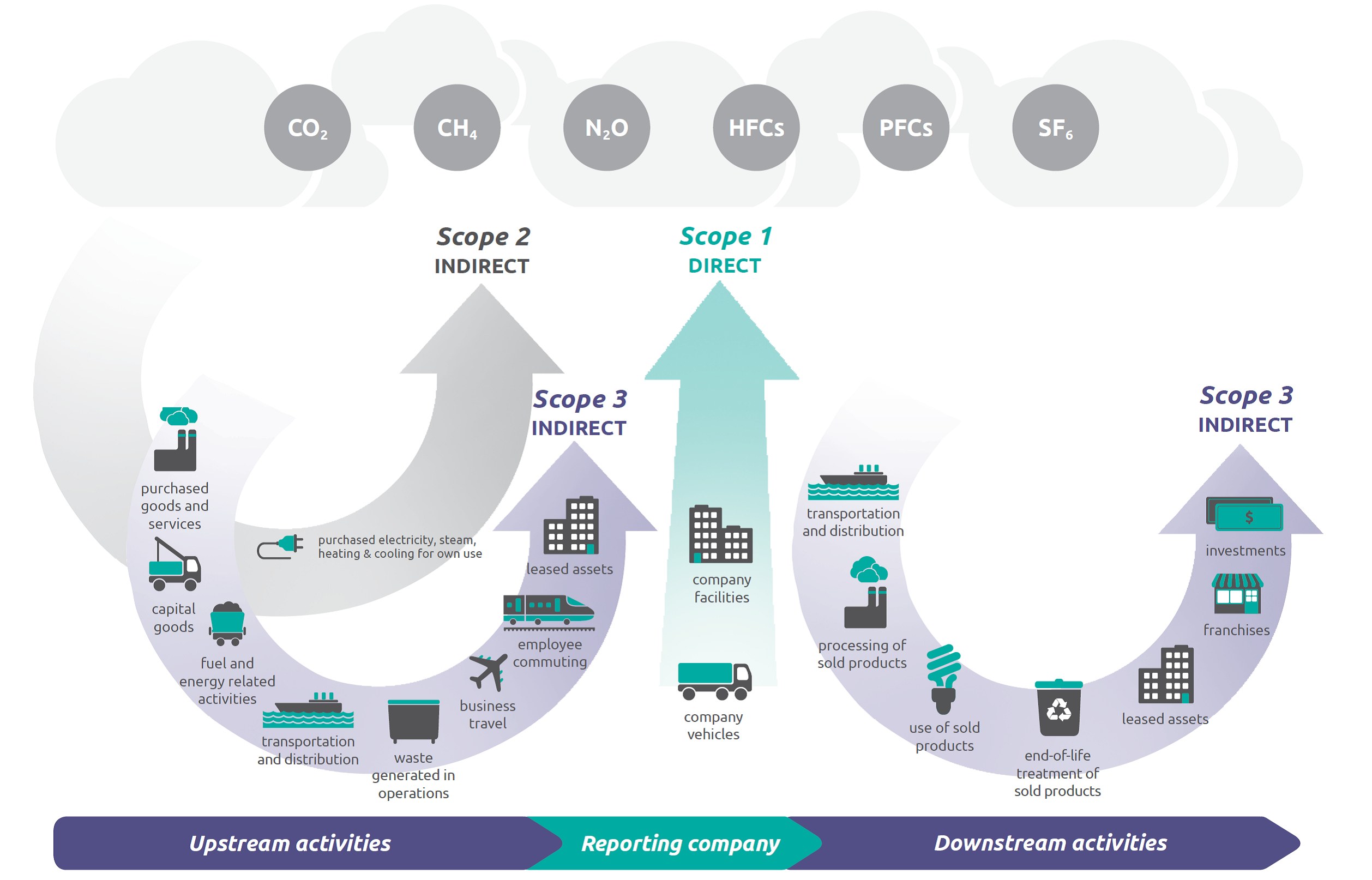
What you burn and release yourself
Emissions from sources your company owns or controls.
- Fuel used in company vehicles
- Gas or oil burned in boilers, furnaces and generators on your sites
- Refrigerant leaks from air conditioning and cooling equipment
- Emissions from your own industrial processes
The energy you buy
Emissions released when the electricity, steam, heating and cooling you purchase are produced. They happen at the power plant, but you cause them by using the energy.
- Electricity for offices, warehouses and factories
- Purchased heat, steam or district cooling
Everything else in your value chain
Emissions from activities you don't own or control, but that happen because of your business. The GHG Protocol splits Scope 3 into 15 categories.
Scope 3 is usually the largest part of a company's footprint, often by a wide margin, and the hardest to measure. It's also the part your customers increasingly ask you about, because your Scope 1 and 2 are part of their Scope 3.
Why measure now
Customers are asking
Large companies need supplier data for their own reporting under rules like California's SB 253 and the EU's CSRD. Read more
Carbon now has a price
Exporters of steel, aluminium, cement and fertiliser to the EU face the CBAM carbon charge, and verified data lowers the bill. Read more
It finds savings
A footprint shows where energy, fuel and materials are being wasted, which is usually where costs are hiding too.
How it works
- ScopeAgree your goals and draw the boundary of what we measure: which sites, entities and emission sources.
- PrioritiseScreen all 15 Scope 3 categories and find which sources matter most for your business.
- CollectGather the data, such as energy bills, fuel cards, travel records, purchase ledgers and waste reports, using simple templates.
- AnalyseCalculate your footprint with recognised emission factors and pinpoint the hotspots.
- ActSet reduction targets and plan the actions that will hit them.
You don't have to measure everything on day one. Many companies start with Scopes 1 and 2 plus the Scope 3 categories where good data exists, then widen the boundary each year as data collection gets easier. When you need more detail, we can go further with the footprint of individual products.
From footprint to Net Zero
Measuring is the first step. Net Zero means cutting your emissions as far as possible, in line with climate science, and only dealing with the small amount that's left through permanent removals. We help you get there in three parts:
- Targets you can defend. Near-term and long-term reduction targets aligned with climate science, ready for validation by the Science Based Targets initiative if you want it. More on SBTi
- A reduction plan. The actions that get you there, costed and sequenced: energy efficiency, renewable electricity, cleaner vehicles, smarter logistics, product design and working with key suppliers.
- Honest claims. Clear guidance on what you can and can't say publicly, including the limits on offsets and "carbon neutral" claims under new rules. Read more
What you get
GHG inventory report
Your Scope 1, 2 and 3 footprint with methods, assumptions and data sources documented.
Hotspot analysis
Where your emissions come from and where the biggest reduction opportunities are.
Targets & roadmap
Reduction targets and a costed Net Zero plan with owners and milestones.
Customer-ready data
Figures packaged for questionnaires, CDP and customer requests.
Repeatable process
Data templates so next year's footprint takes a fraction of the time.
Common questions
What data do we need to get started?
For Scopes 1 and 2: fuel and energy bills, vehicle fuel records and any refrigerant top-ups. For Scope 3 we usually start from your purchase ledger, travel records and waste invoices. We'll give you templates and work from whatever you have.
Do we have to measure Scope 3?
Not always on day one, but most companies that set credible targets, or that sell to large customers, will need at least a screening of Scope 3. It's where most emissions sit, so leaving it out can hide your biggest opportunities.
Can we say we're "carbon neutral"?
Be careful. In the EU, claims that a product is carbon neutral based on offsetting are now banned in consumer marketing, and regulators elsewhere are tightening up too. We'll help you make claims that are specific, accurate and backed by evidence.
How often should we measure?
Once a year, for the same period as your financial year. That gives you a consistent trend to track against your targets.
Get started
Ready to see where your business stands?
Book a free 30-minute call. No slide deck, no sales pitch — just a straight read on where you stand, and what a realistic first step looks like.